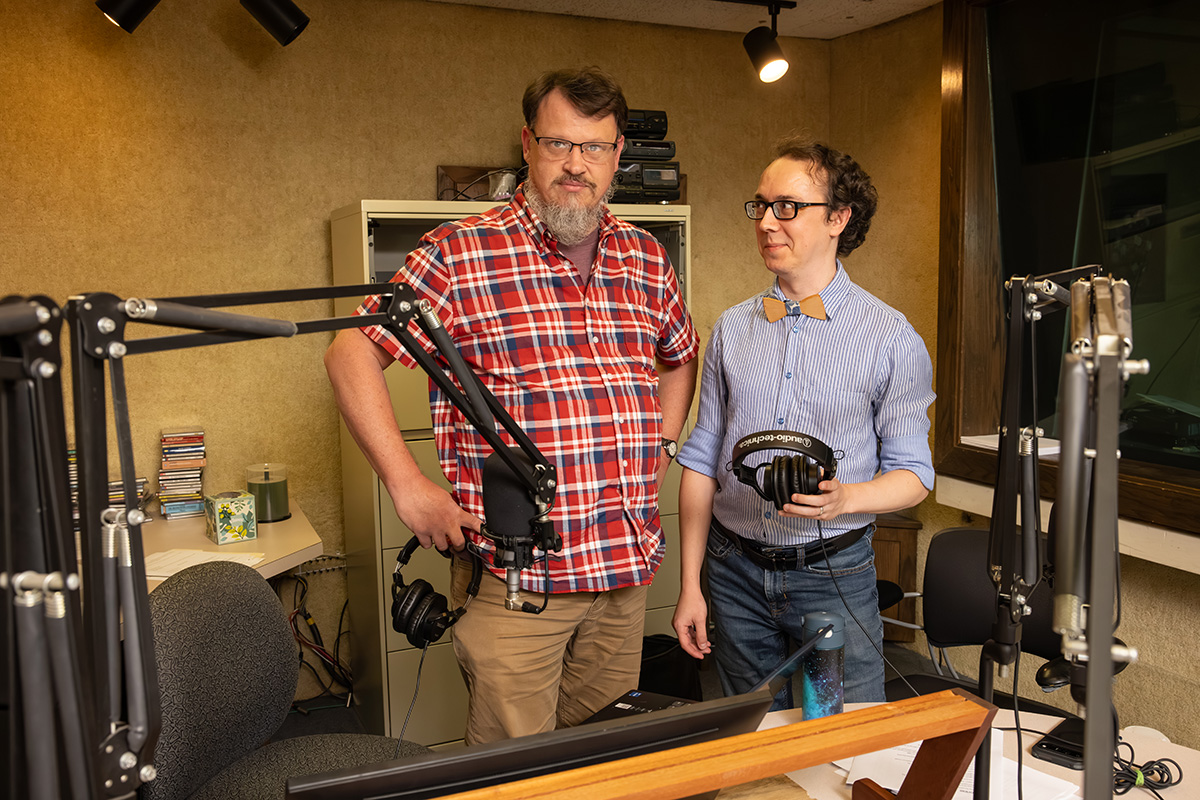
Brian Cross, Associate Professor of Biology, and Matt Smith, Ph.D., Associate Professor of Chemistry, co-host Yackety Science, a Public Radio Tulsa podcast that blends the latest science headlines and obscure facts with humor and curiosity.
“We’re yacking back and forth. That’s the idea behind the podcast,” says Smith. “We have fun bantering and talking about science in a way the average listener can enjoy. We try to make it more approachable, and also funnier. And honestly, there are just some topics we like talking about.”
“The magic of the podcast is riffing off each other,” says Cross. “It wouldn’t be the same if I were just sitting there talking.”
Cross and Smith have officed next door to each other at TCC’s Metro Campus for more than a decade. After years of trading wisecracks, they realized their musings might resonate with a broader audience.
“I poked my head into Matt’s office and said, ‘Hey, want to make a podcast?’ Then we just started brainstorming,” says Cross. “It’s not a great origin story. I don’t even know exactly why the idea popped into my head. Just … why not?”
First conceived in 2022, the podcast didn’t get picked up until 2024. Yackety Science found a home with Public Radio Tulsa, and the first episode aired in March 2025. New episodes drop twice a month.
Cross and Smith split their recording time between the KWGS studio, housed on the University of Tulsa campus, and the McKeon Center for Creativity just across the street from the Metro Campus.
“TCC has the facilities, the resources, and the encouragement to take on projects like this. I really appreciate that,” says Smith.
“One of the reasons this is such a great job is because we have some flexibility,” Cross says. “So, when I get an idea—like this podcast—I actually have time to pursue it.”
Though both call teaching at TCC a great gig, neither expected their careers to lead here.
Smith, a TCC alumnus, originally studied Computer Science until a Chemistry course inspired him to change professions.
“My mom was a chemistry teacher, and my dad’s a clown, so I guess that’s where I get it,” Smith says. “I ended up working as a tutor and a lab assistant at TCC before transferring to Northeastern State University for my bachelor’s degree and eventually going to grad school at the University of Tulsa. Now I’m back as a professor.”
Cross says he always knew he’d chase a career in science. He was fascinated by animals as a child, starting with a giant collection of stuffed animals, and later worked at the Tulsa Zoo in the large mammal department.
“I got to help with root canals on a polar bear once. I still remember the dentist doing like five or six root canals,” he says.
Cross studied Zoology at the University of Oklahoma and served in the Peace Corps as an environmental education volunteer in West Africa before returning to Oklahoma to complete a master’s degree at Oklahoma State University.
Cross and Smith’s combined knowledge and experience allow them to cover a wide array of science topics. One recurring segment busts bad movie science, like Jurassic Park’s infamous frog-DNA experiment.
“This is something I’ve talked to my students about. The main problem was that they used frog DNA to fill in dinosaur DNA. Frogs aren’t closely related to dinosaurs,” says Cross. “The better way would be to start with a chicken and tweak its genes, because birds are a type of dinosaur. So, if you want to resurrect the scary Mesozoic dinosaurs, the easiest place to start is with the dinosaurs that are still here, that is, birds.”
The learning doesn’t stop with the listeners. Even the hosts are gaining new knowledge with each episode.
“We’ve had to do a lot of research for the podcast on the latest industry developments,” says Smith. “I’ve learned a ton of biology, and Brian’s picking up chemistry.”
The co-hosts agree that while they aim to entertain, the mission of Yackety Science is to demonstrate the prevalence and accessibility of science, regardless of the listeners’ background or expertise.
“Even if you never touch chemistry again, just training your brain to approach problems differently is worthwhile,” says Smith. “Science teaches you how to think critically, which is useful whether you’re going into accounting, law, or anything else. It’s about building versatile ways to think.”
“We want to help people build a better understanding of the natural world,” says Cross. “The hope is that listeners will become more interested in science, value it more, and become better-informed citizens.”
Whether the podcast co-hosts are swapping science jokes or breaking down the latest research, Cross and Smith prove that learning doesn’t have to be boring.