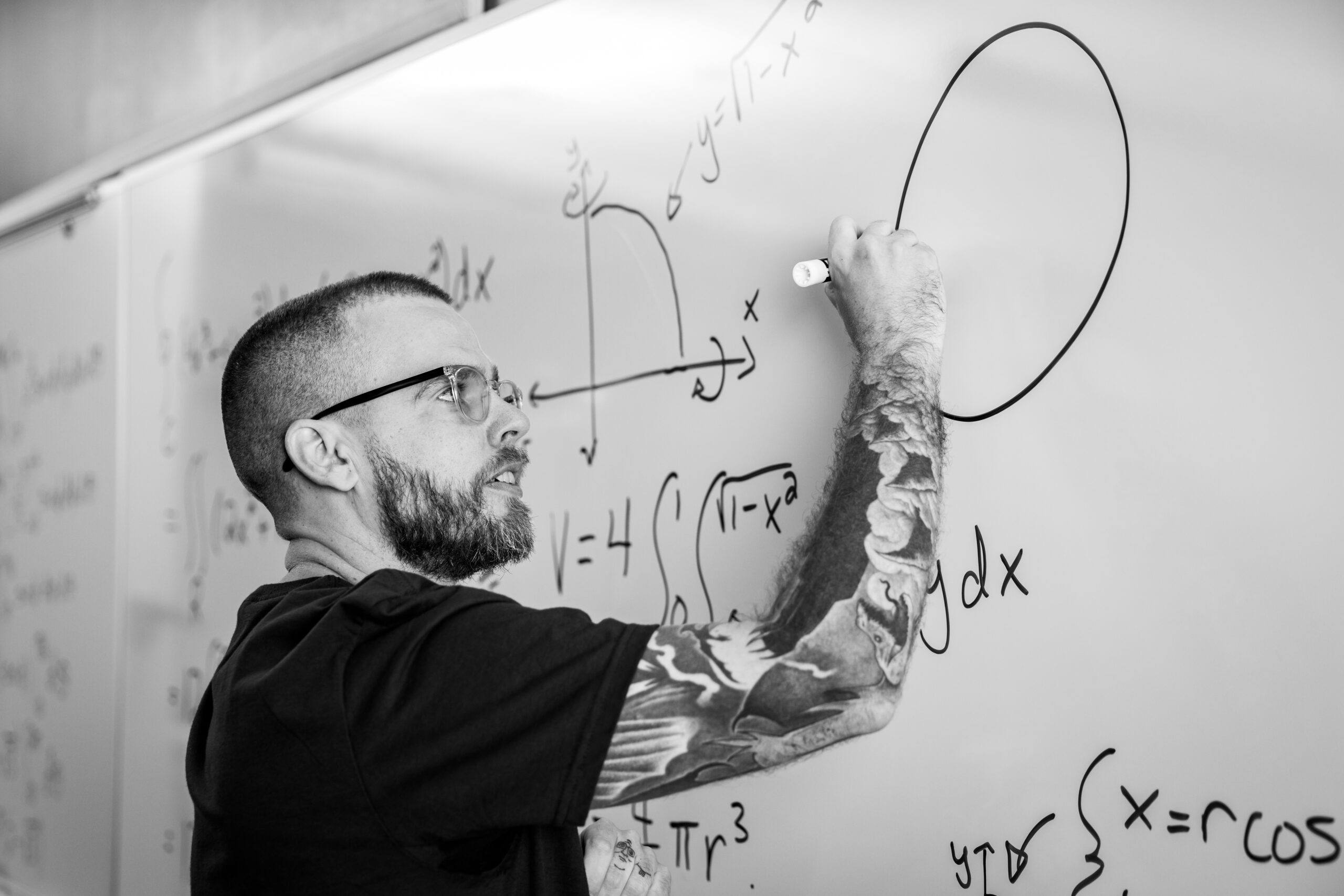
Helping students find confidence and community through the Integration Bee
When Joshua Gregory joined TCC in Fall 2021 as an Assistant Professor of Mathematics, he didn’t just bring his expertise in calculus, he brought a passion for helping students see math as approachable, collaborative, and even … fun.
Growing up in Glenpool, Oklahoma, Gregory never planned to become a teacher. In fact, his first career ambition was music.
“While touring with a band, a younger friend needed help with geometry,” he says. “I unexpectedly fell in love with the challenge of breaking down complex math concepts into understandable pieces. That’s when I realized I had a knack for teaching.”

Though he still plays music, math now takes center stage in his professional life. After graduating from TCC with an associate degree in Education in 2011, he earned a bachelor’s in Mathematics Education from Northeastern State University and a master’s in Mathematics from the University of Arkansas, teaching middle school and high school math before moving to the College.
One of the highlights of Gregory’s year is leading TCC’s Integration Bee, a unique, Spring-semester-only competition funded in part by the TCC Foundation. The event focuses on integration, a cornerstone of calculus used to model cumulative effects in science, engineering, economics, and beyond.
Unlike a traditional test, the Integration Bee blends intellectual rigor with a lively, low-pressure environment. Students compete in both individual and team formats, with no grades at stake.
“It’s a chance for them to gauge their understanding with minimal risk while fostering peer learning,” Gregory says. “The goal is to build community and inject energy into a typically lecture-heavy course.”
The event regularly attracts students from Calculus II, Calculus III, and Differential Equations. Gregory has hosted two Bees since taking the lead, with more than 50 students competing in Spring 2024 alone. The format encourages collaboration, even among competitors.
“During the final knockout round this year, the last two teams tackled a tough problem while eliminated students worked on it independently. The energy was incredible, students collaborating on a Thursday night purely for the joy of math, and maybe prize money,” he says.
Gregory adds that preparing for the Bee often changes how students approach calculus.
“Studying for a competition is different from preparing for an exam,” he says. “Students are often more willing to spend extra time working in groups, sharing strategies, and realizing they’re not alone in their struggles. That peer-to-peer instruction is incredibly powerful.”
The feedback has been consistently positive, with comments like, “I did better than I expected and feel more confident for my final exam”; “I realized I need to ask for help sooner”; and “I didn’t think math competitions could be fun!”
The event appeal is more than intellectual. Thanks to support from the TCC Foundation, winners receive gift cards, a motivating factor for some students who might not otherwise participate.
“We also provide food donated by Student Life,” Gregory says. “The prizes and atmosphere make students more likely to try something new, even if they’re unsure at first.”
Quick to thank the donors who make that support possible, Gregory says, “Community in STEM is beyond important to our future. Funding from the TCC Foundation provides a safe, low-risk environment for students to improve their understanding and build relationships that could change the world.”
Looking ahead, Gregory hopes to expand the Integration Bee to twice a year and eventually lead a regional competition involving nearby universities. He also wants to grow participation through stronger promotion and word-of-mouth from past competitors.
No matter how the event evolves, Gregory’s goals remain the same: helping students find confidence in math and community in each other.
“Whether they gain self-assurance, motivation from peers, or simply see the value of a math community, I hope every participant walks away believing they can succeed in STEM.”